On the afternoon of May 7, 2026, a lecture titled "Pakistan's Search for Peace with Afghanistan: Statecraft, Policy, and Strategy," hosted by the Institute of International and Strategic Studies (IISS), Peking University (PKU), was successfully held at the North Pavilion of PKU. The lecture was delivered by Dr. Muhammad Zahid Latif, Rector of the National University of Sciences & Technology (NUST) of Pakistan and a retired Lieutenant General, with commentary by Zhang Qingmin, Professor at the School of International Studies (SIS), PKU, and was chaired by Professor Yu Tiejun, President of IISS, PKU.
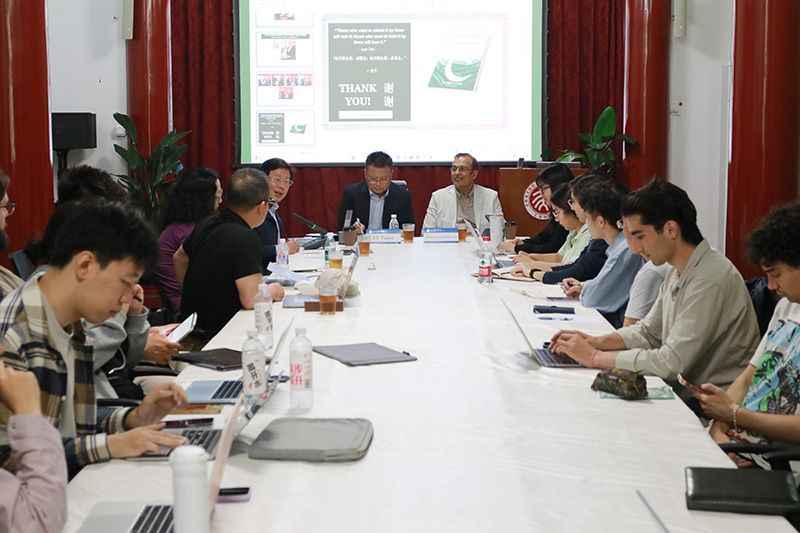
Dr. Latif's presentation focused primarily on the origins, research approach, and overall framework of his new book of the same name, Pakistan's Search for Peace with Afghanistan: Statecraft, Policy, and Strategy. Drawing on his long experience in Pakistan-Afghanistan border security, military diplomacy, and academic research, he traced the book's development from initial concept to formal publication, noting that his original motivation for writing it was to reflect on the historical successes and failures of Pakistan's Afghanistan policy and to explore practical pathways for reducing conflict and improving people's livelihoods. He then described the book's distinctive feature of combining policy-practice and academic-research perspectives, emphasizing its extensive use of primary sources and its incorporation of a wide range of views from academic and political circles in Pakistan, Afghanistan, and the West. Finally, he outlined the book's overall structure, organized into three parts: historical description, policy analysis, and recommendations for the future.

The discussant, Professor Zhang Qingmin, strongly affirmed the book's important value in combining frontline practical experience with academic research, while raising avenues for further reflection on whether the theory of "power and interdependence" is sufficient to explain such complex factors in Pakistan-Afghanistan relations as ethnicity, identity, and historical structures. Questions from the audience centered on the practical dilemmas confronting Pakistan's policy toward Afghanistan, ranging from border security, geo-economic cooperation, and regional connectivity to the interplay between the policy towards Afghanistan and domestic governance. In response, Dr. Latif observed that Pakistan's Afghanistan policy had long fallen short of its goals — a result both of past overreliance on "high politics" and security-driven approaches and of structural weaknesses in domestic governance. The more viable way forward, he argued, lies in fostering institutional interdependence; coordinating border governance, trade and economic links, and regional cooperation; strengthening people-centered exchanges; and advancing connectivity within a geo-economic framework so as to break free from the vicious cycle of proxy politics and military confrontation.
The book Pakistan's Search for Peace with Afghanistan examines the evolution and effectiveness of Pakistan's policy toward Afghanistan from the end of the Cold War to the final U.S. withdrawal in 2021, seeking to explain why Pakistan has long been unable to build a stable and peaceful relationship with Afghanistan, its key western neighbor. Departing from traditional analytical frameworks centered on geopolitical competition and security rivalry, the book calls for rethinking a policy approach overly dependent on military means and "high politics," and turns instead to institutional interdependence, public welfare, and regional connectivity in exploring possible directions for resetting Pakistan-Afghanistan relations. Grounded in the author's long practical experience in the military, security, and diplomatic spheres, as well as his systematic study of primary sources, the book offers a valuable reference for understanding both the historical predicament and the future trajectory of Pakistan-Afghanistan relations.
Editor: Li Fangqi Photo by: Zheng Huaizhou


 Features