On the evening of September 4, 2026, the Institute of International and Strategic Studies (IISS), Peking University (PKU) held the 101st session of the North Pavilion Seminar lecture series, titled " Why the Reduction of Tensions in Sino-American Relations is Difficult." The lecture was delivered by Thomas J. Christensen, James T. Shotwell Professor of International Relations at the School of International and Public Affairs (SIPA), Columbia University, and Director of the China and the World Program, and chaired by Gui Yongtao, Vice President of IISS and Associate Dean of the School of International Studies (SIS), PKU.
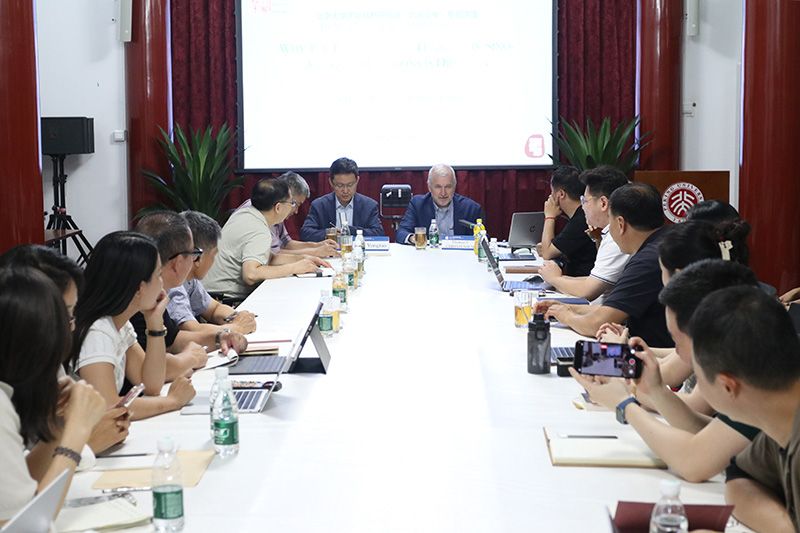
Prof. Christensen began by reviewing the recent meetings between the Chinese and U.S. leaders and developments in bilateral relations. He noted that through their two meetings in 2025 and 2026, the two sides temporarily eased tensions over issues such as tariffs and rare earth export controls, and made some progress in areas including cooperation on non-strategic trade. While some observers regard this as a positive sign that China-U.S. relations are stabilizing, Prof. Christensen argued that the current situation is not a comprehensive detente but a "truce," and that bilateral relations may be buffeted by economic friction and international security issues in the future.
On the economic front, Prof. Christensen noted that the United States has in recent years placed growing emphasis on protecting manufacturing and has tended to use tariffs as a policy tool for achieving economic and diplomatic goals. However, U.S. tariffs on China have not brought about a large-scale return of manufacturing; instead, they have pushed some supply chains to shift to countries such as Vietnam and Mexico, which remain closely linked to Chinese supply chains. Unilateral tariffs, therefore, can hardly resolve the structural problems in China-U.S. economic and trade relations. A more constructive approach would be to diversify trade and supply chains through multilateral cooperation. Economic interdependence between China and the United States not only has economic value but also raises the cost of conflict, providing a degree of security for the bilateral relationship.
On global political and security issues, differences over Russia, Iran and other matters may also become new sources of friction. Prof. Christensen suggested that the Trump administration may continue to pressure China through tariffs, financial sanctions and export controls. On the Taiwan question, he argued that U.S. policy toward Taiwan should remain stable and predictable, and that arms sales to Taiwan should not be used as a bargaining chip in dealing with other issues between China and the United States; otherwise, this could lead to miscalculation and unrealistic expectations, and increase uncertainty in the cross-Strait situation.
While analyzing the risks, Prof. Christensen also pointed out that there remains some room for cooperation between China and the United States. The first is to conduct multilateral negotiations on artificial intelligence safety, aimed at jointly establishing international norms and safety guardrails to keep AI from slipping out of engineers' control. The second is to strengthen professional cooperation on the control of fentanyl and its precursor chemicals. The third is to jointly maintain global financial stability. The fourth is to coordinate on issues such as food security in developing countries.
In the Q&A session, Prof. Christensen exchanged views with faculty members and students on issues including the control of fentanyl and new psychoactive substances, the impact of the U.S. midterm elections on China policy, and the reasons behind the Trump administration's different approaches to Iran and North Korea.(Contributed by Yu Yiyan)
Editor: Li Fangqi Photographer: Zheng Huaizhou


 Features