On June 11, 2026, the Institute of International and Strategic Studies (IISS), Peking University (PKU) held the 100th session of the North Pavilion Seminar lecture series, titled "What Trap? Great Power Decline and Retrenchment." The lecture was delivered by Joseph M. Parent, Professor of Political Science at the University of Notre Dame, and chaired by Gui Yongtao, Vice President of IISS and Associate Dean of the School of International Studies (SIS), PKU.
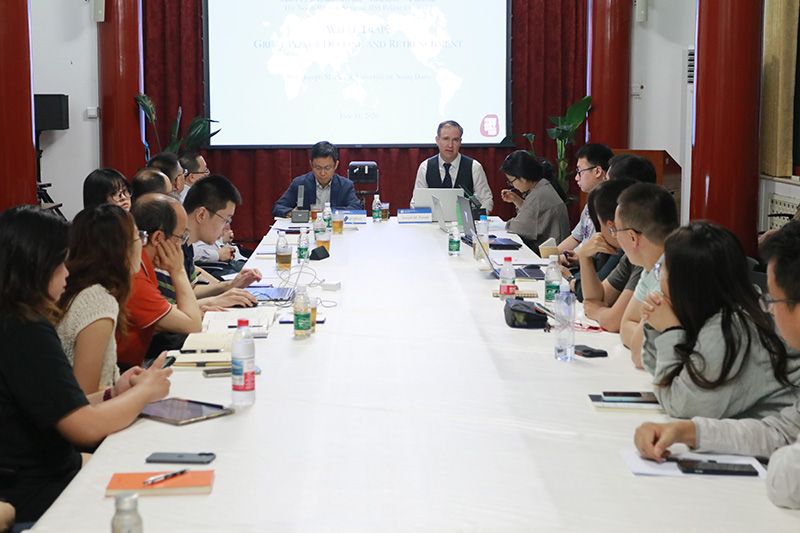
Prof. Parent noted that prevailing views on how great power decline affects international politics tend to be pessimistic: power transitions may intensify security competition, and domestic political dysfunction may keep states from adjusting in time. The "Thucydides Trap" is representative of this line of thinking. In response, he argued that existing scholarship has paid insufficient attention to retrenchment following great power decline, and that it is necessary to reexamine how states actually respond when their relative power declines.
Parent defined great power decline as a sustained fall in a state's relative share of the great powers' combined GDP and in its ranking among them, and retrenchment as a state's deliberate scaling back of its grand strategic ends and reduction of the costs it is willing to bear to sustain existing external commitments. Retrenchment is not the same as appeasement or isolationism; rather, it is an overall readjustment of a state's military, diplomatic and economic resources.
At the theoretical level, Parent argued that great power decline does not necessarily lead to risky behavior. The constraints of power politics tend to push states toward relatively prudent adjustments, which is why retrenchment is their most common response. At the same time, the pace of decline determines the extent and form of retrenchment. When decline is gradual, states rely more on domestic measures such as cutting spending, restructuring their armed forces and pursuing institutional reform; when decline is rapid, they are more likely to adjust by redeploying forces, reducing their strategic exposure and encouraging allies to share more of the burden. In addition, structural conditions such as a state's relative ranking, the availability of allies, the degree of interconnection among existing commitments, and the relative ease of conquest and defense also shape states' grand strategic choices.
At the empirical level, drawing on cases of great powers since 1870, Parent noted that retrenchment can be observed in 63 to 81 percent of the relevant cases. Once states recognize their relative decline, they tend to make adjustments of varying degrees at both domestic and international levels, and the pace of decline goes a long way toward explaining the intensity of retrenchment and the mix of policies adopted. He therefore emphasized that great power decline does not necessarily lead to war, and that moderate retrenchment is more conducive to preserving strength and easing strategic overextension.
In the Q&A session, Parent exchanged views with faculty members and students on issues including how national decline is measured and perceived, how U.S. retrenchment has manifested itself in practice, the role of structural conditions and status politics, and the relationship among retrenchment, reform and military capabilities.(Contributed by Shi Wenlü)


 Features