On the evening of May 21, 2026, a lecture on "Rethinking the Relationship between Economics and Security in an Era of Great Power Competition" was held at the North Pavilion of Peking University (PKU) and online simultaneously. The event was jointly organized by the School of International Studies (SIS), PKU, the Institute of International and Strategic Studies (IISS), PKU, and the China Office of Princeton University Press.

The lecture was delivered by Stephen G. Brooks, Professor of Government at Dartmouth College. The discussants were Zhang Falin, Professor and Associate Dean of the Zhou Enlai School of Government, Nankai University (participating online); Jie Dalei, Guest Research Fellow of IISS and Associate Professor at SIS, PKU; and Lian Chenchao, Lecturer at the School of International Studies, Renmin University of China. The event was chaired by Yu Tiejun, President of IISS and Professor at SIS, PKU.
In the lecture, Prof. Brooks introduced the origins, structure and central arguments of his new book, The Political Economy of Security. He noted that the interaction between economics and security matters for all countries, and is especially critical for China and the United States as the world's two major powers. The book seeks to provide a systematic understanding of the economics-security relationship at both the empirical and the theoretical level. In the empirical part, he identifies sixteen significant pathways through which economic variables shape security affairs, systematically examining how international trade, globalized production, financial flows, economic development and natural resources bear on interstate conflict, civil war and terrorism. In the theoretical part, he focuses on three questions: how economic and security objectives relate to each other, which economic factors deserve the most attention, and how economic actors influence security policy. He also revisits Adam Smith's The Wealth of Nations for its insights into the relationship between economics and security. Brooks emphasized that the effects of economic factors on security are neither unidirectional nor linear, but highly conditional, complex and dynamic: they can be reduced neither to "promoting peace" nor to "aggravating conflict."
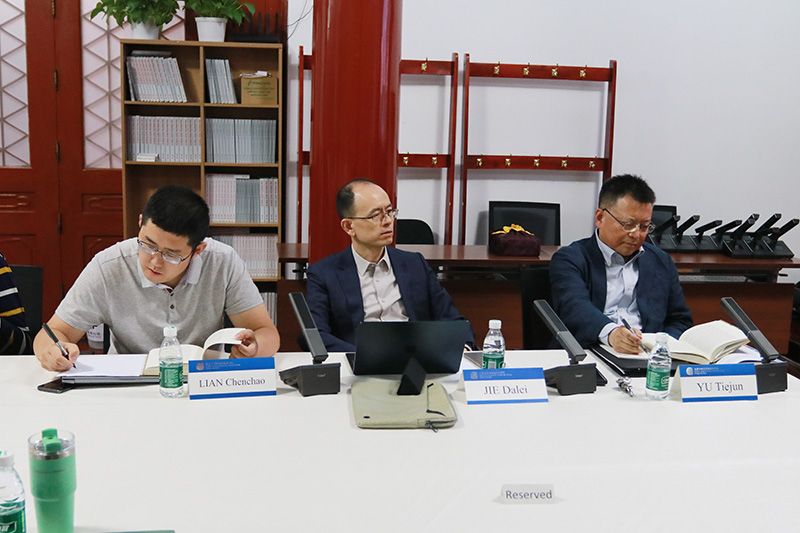
In the commentary session, the discussants addressed the book's research design, theoretical innovation and practical relevance. Zhang Falin observed that the book is valuable both as a systematic review of the field and as original research, and that it offers insights for bringing new topics such as artificial intelligence, the digital economy and semiconductors into the analytical framework of economics and security. Jie Dalei argued that the book has considerable practical relevance for understanding the international political and economic landscape of the present era of "competitive interdependence," and is particularly helpful for further reflection on balancing development and security. He also raised questions about the theoretical boundaries of realist political economy, the time lag in converting economic resources into military capabilities, and the policy logic of China-U.S. competition in high technology. Lian Chenchao commended the author's attention to economic structure as a key variable, finding his analysis of land-based, industrial and knowledge-based economic structures and their security implications especially illuminating. He also exchanged views with the speaker on structural transformation, the use of force and deterrence, and the interaction among different pathways.
In the interaction and Q&A session, Prof. Brooks explained further that the sixteen pathways set out in the book are not an exhaustive list: some derive directly from his rereading of Adam Smith, while others are extensions built on existing research findings and suggestions from the scholarly community. He noted that one important direction for future research is to move beyond the analysis of individual pathways and examine how different pathways overlap, offset one another and jointly shape security outcomes. Faculty members and students on site also had an in-depth exchange with the speaker on theories of the "commercial peace," the theoretical divide between realism and liberalism, the distinction between the initiation and the duration of war, and the relationship between empirical research and normative judgment. Prof. Brooks said that understanding the relationship between economics and security depends on grasping the structural conditions, causal mechanisms and historical evolution behind it, rather than resorting to simplistic conclusions.
The Political Economy of Security was published by Princeton University Press in 2026. The book offers a systematic account of the multiple mechanisms through which economic factors affect security affairs, and emphasizes that there is no unidirectional or stable causal relationship between economics and security; rather, their effects are complex and varied under different conditions. This event was the seventh session of the lecture series on Frontiers of International Relations Theory.
Editor: Li Fangqi Photographer: Zheng Huaizhou


 Features