On the evening of March 27, 2026, the Institute of International and Strategic Studies (IISS), Peking University (PKU) successfully held the 95th "North Pavilion Seminar" lecture series, themed "Political Change in Western Europe in a Turbulent World." The lecture was delivered by Chen Yuhui, Assistant Research Fellow at the Institute of Political Science and Secretary-General of the Center for International Chinese Studies, Chinese Academy of Social Sciences (CASS), and was chaired by Gui Yongtao, Vice President of IISS, PKU, and Deputy Dean of the School of International Studies, Peking University.
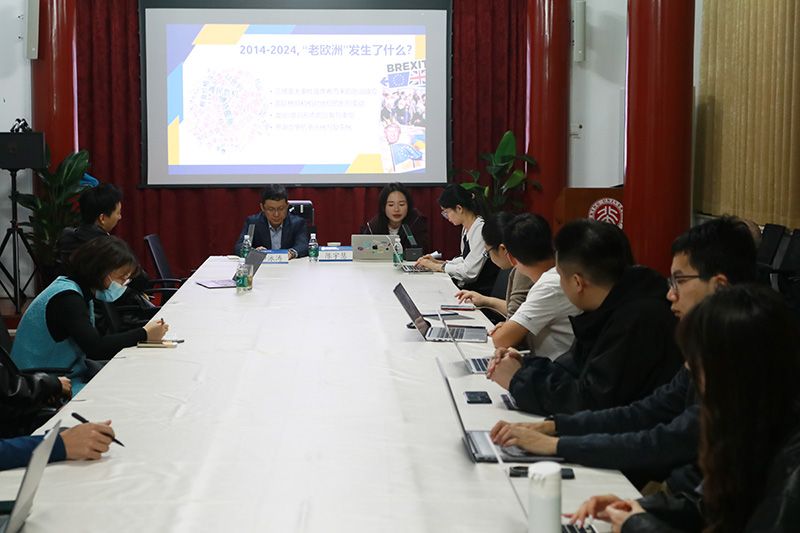
Chen Yuhui first identified, along four dimensions, the profound changes that have taken place in Europe between 2014 and 2024. First, three major events—Brexit, the COVID-19 pandemic, and the Ukraine crisis — and their spillover effects continue to reverberate through European politics. Second, dramatic shifts in both the international landscape and the relative positions have generated an affective tendency of strategic unease within EU member states. Third, political parties and ideologies within EU member states are undergoing fragmentation and realignment. Fourth, with the rise of social media, the competition among intellectual currents has grown increasingly diverse and complex.
Based on Europe's current political situation and her own field experience, Chen Yuhui pointed out that European politics has been growing increasingly complex over the past decade.
To present the EU's political changes more clearly and intuitively, she approached the question from the disciplinary foundation of comparative politics. Examining the results of European Parliament elections and selected regional elections from 2014 to 2024 at the NUTS 3 level, she conducted a comparative analysis of the vote shares of different parties across six countries — France, Germany, Italy, the Netherlands, Belgium, and Spain. Chen Yuhui summarized her findings with three keywords: "shift to the right," "polarization," and "the retreat of the mainstream." She noted that the focus of elections and political issues in Europe has shifted overall toward the right of the political spectrum, the traditional centrist camp's influence is contracting in certain regions, and the relative shares held by forces at both ends of the spectrum and anti-establishment forces are rising.
To probe the reasons behind this political phenomenon, Chen Yuhui explained, from three aspects — the appeal of discourse, the effectiveness of political mobilization, and modes of communication — how these factors compound one another across different regions, driving the shifting balance between the centrist camp and polarized politics. This finding offers important insights into a deeper understanding of the realignment of Western Europe's political landscape.
During the interactive session, Chen Yuhui engaged in an in-depth exchange with the faculty and students present at the lecture on topics including the strategic leanings of different parties' campaigns, the impact of social media on shifts in voter preferences, and the connection between European political change and issues such as climate and Syrian refugees. The exchange deepened the audience's understanding and awareness of political change in Western Europe. (Contributed by Cheng Xueyan)
Editor: Li Fangqi Photo by: Zheng Huaizhou


 Features