On June 26, 2026, Prof. Yu Tiejun, President of the Institute of International and Strategic Studies (IISS), Peking University (PKU), traveled to Seoul, the Republic of Korea (ROK), upon invitation to attend the 2026 Korean Peninsula Symposium and High-Level International Forum on "Global Polycrisis and the Korean Peninsula," jointly organized by Yonhap News Agency, the ROK Ministry of Unification, and the Institute for National Security Strategy (INSS). In his speech at the forum, entitled "The Evolving Security Landscape in Northeast Asia and Peace and Development on the Korean Peninsula," he made clear that there has been no change in either China's policy toward the Democratic People's Republic of Korea (DPRK) or its principle of denuclearization of the peninsula. China will develop its traditional friendship with the DPRK, keep it abreast of the times, give it more substantive content, and expand bilateral measures that benefit the peoples of both countries.
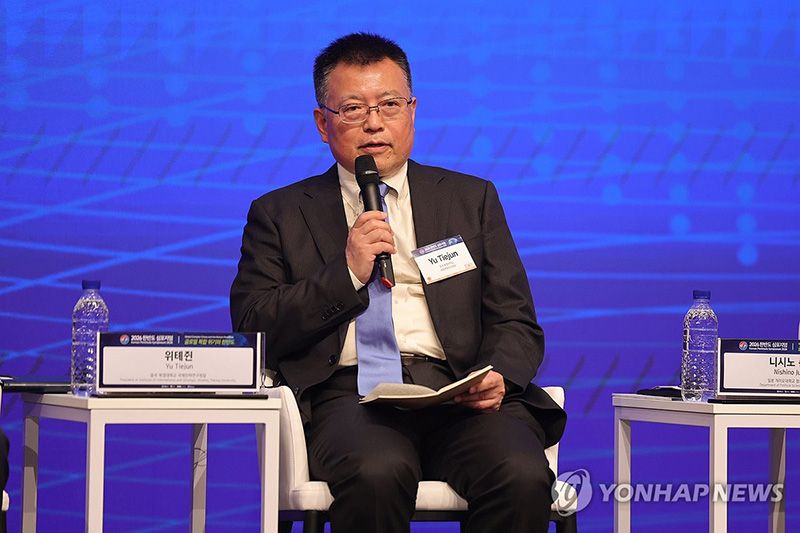
Before the forum began, Professor Yu gave an interview to Yonhap. He said that the ROK government needs to act as a force for stability in its diplomacy and to manage its bilateral relations with all parties well. China hopes to work with the ROK so that the two countries serve as forces for stability together, and opposes the trend toward strengthening military alliances in Northeast Asia. He noted that the security architecture of East Asia has long been essentially a set of U.S.-centered bilateral alliances. Since the second Trump administration took office, however, the United States has made some adjustments to its alliance policy, which presents the ROK with new challenges.
Professor Yu analyzed that the peninsula is facing multiple tests, but that the ROK is in a relatively favorable position geopolitically. Against this backdrop, he said, the ROK should act as a force for stability and manage its bilateral relations with all parties well. What China emphasizes at the diplomatic level is precisely being "a force for stability in a turbulent world." China wants to see a more stable world, and hopes to see a more stable peninsula.
The event was jointly organized by Yonhap News Agency, the ROK Ministry of Unification, the Institute for National Security Strategy (INSS), and Yonhap's Northeast Asia Center. Attendees that day included Han Byung-do, acting leader and floor leader of the ruling Democratic Party of Korea; Jang Dong-hyuk, leader of the main opposition People Power Party; Seoul Mayor Oh Se-hoon; and Dai Bing, Chinese Ambassador to the ROK, among figures from various sectors.
Seong Ghi-hong, Senior Secretary for Public Relations and Communication at Cheong Wa Dae (the ROK presidential office) and former president of Yonhap News Agency, attended the event and read out a congratulatory message from President Lee Jae Myung. In the message, President Lee said that the world is facing multiple crises and that his government would pursue "pragmatic diplomacy centered on national interests," respond effectively to changes in the global situation, and seek solutions capable of overcoming these crises. The ROK, he said, would strengthen ROK-U.S.-Japan cooperation and maintain sound relations with neighboring countries on the basis of mutual respect and deepened cooperation.
Launched in 2015, the Korean Peninsula Symposium is held annually by Yonhap News Agency, the Ministry of Unification and other institutions. This year's edition, the 12th, aimed to bring together political figures, experts and scholars from home and abroad to assess the situation on the Korean Peninsula and put forward workable policy recommendations.
Editor: Li Fangqi


 Features